Project
←Back to projects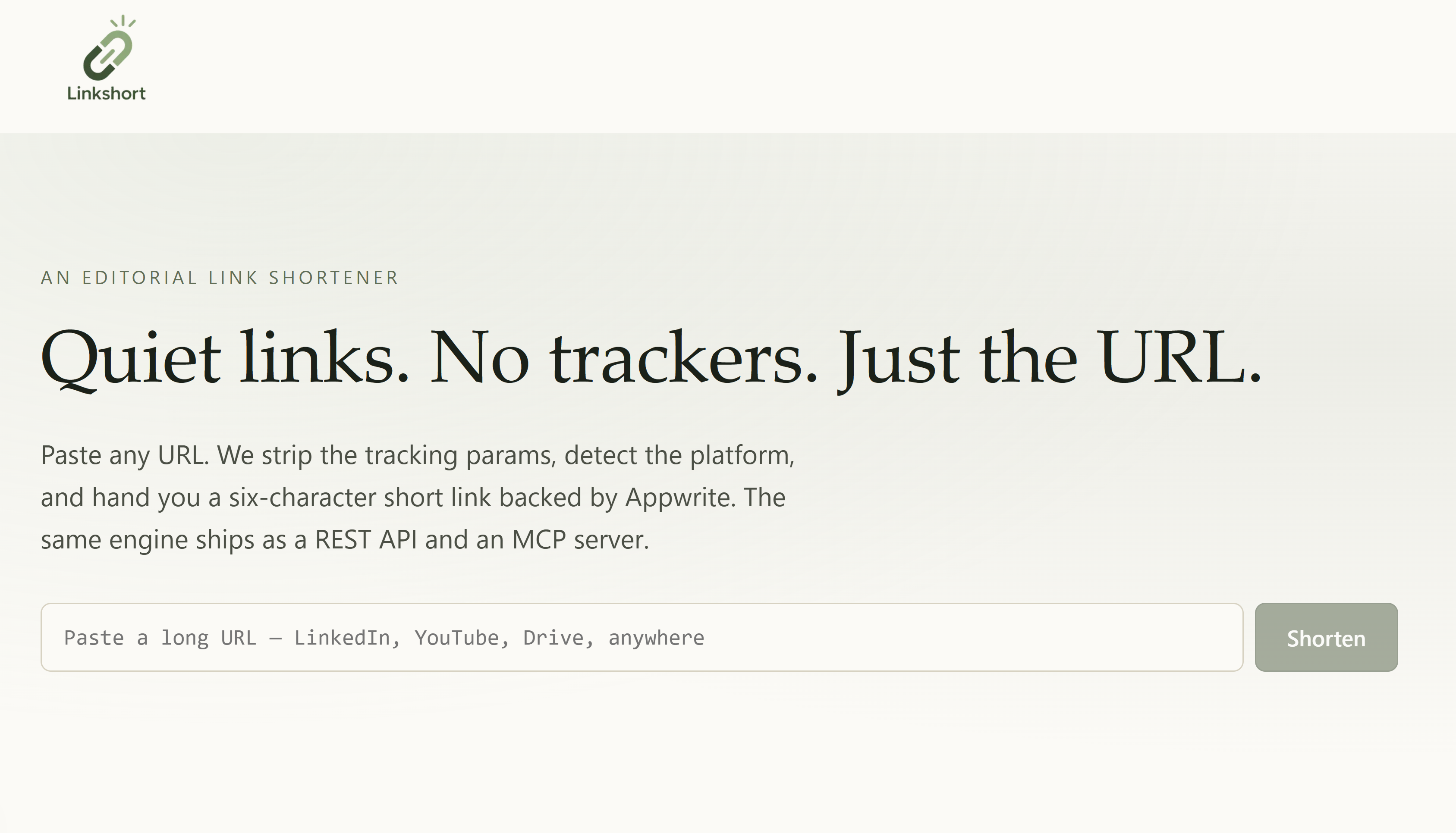
april 29, 2026
Shortlinks
Shortlinks
A privacy-first, editorial link shortener that strips tracking parameters before storing, detects the originating platform across 23 services, and exposes the same core engine through three interfaces: a website, a REST API, and an MCP server for AI agents.
Overview
Most link shorteners monetize click analytics, which means tracking identifiers embedded in URLs are preserved — or even augmented — on the way through. Shortlinks inverts this: tracking parameters are stripped at creation time, the cleaned URL is what gets stored and served, and click counts are stored as a single aggregate integer with no session data attached. The system is backed by Appwrite for storage and rate limiting, deployed on Next.js App Router.
Architecture
The core logic is a shared service layer consumed by all three interfaces. URL cleaning, platform detection, slug generation, rate limiting, and link storage are implemented once and not duplicated per interface.
URL Cleaning
The cleaner parses the input URL and drops any query parameter that matches a known tracking identifier. The match list covers prefix-based patterns (utm_*, mc_*, pk_*, hsa_*, _hs*, oly_*, vero_*) and an exact-match set of over thirty identifiers including fbclid, gclid, msclkid, igshid, igsh, twclid, yclid, spm, _ga, _gl, and their platform-specific variants.
Platform-functional parameters are preserved — YouTube's v= and list=, Google Drive file IDs, document fragment anchors. The constraint is that cleaning must never break a link. Both the original URL and the cleaned URL are stored, providing a verifiable audit trail.
Platform Detection
Platform detection is a regex match against the URL hostname, covering 23 services: LinkedIn, YouTube, Instagram, X/Twitter, Google Drive, Docs, Sheets, Forms, Maps, Facebook, TikTok, Reddit, GitHub, Notion, Figma, Amazon, Medium, WhatsApp, Telegram, Discord, Spotify, Pinterest, and a web fallback. Detection is metadata only — it informs the stored record and the human-readable path segment but does not affect redirect behavior.
Link Storage and Slug Generation
Short links are stored in Appwrite as documents keyed by their slug. Slug generation retries up to six times on conflict before failing. Reserved slugs (for internal routes like api, docs) are excluded from generation. A link record carries: slug, original URL, cleaned URL, platform, platform host, creator identity, click count, active flag, and optional expiry.
Redirects are served from a flat App Router catch-all route that increments clickCount in Appwrite on each hit. The increment is best-effort and never blocks the redirect response.
Rate Limiting
Rate limiting is implemented without storing raw IP addresses. Each identity — derived from an API key header or a hashed IP — is passed through SHA-256 before being used as a database key. The limit is 2 creations per second per identity.
The rate limiter creates a document for each {scope, identityHash, windowStart} tuple. On conflict (document already exists for this window), it increments a bounded attribute in Appwrite using incrementDocumentAttribute with a ceiling. If the ceiling is exceeded, Appwrite returns an error that maps to a 429. Documents expire 60 seconds after their window, eliminating the need for a separate cleanup job.
Interfaces
Website
A single-page form: paste a URL, receive a short link. The form validates client-side and calls the REST API. There is no account, no email wall, no cookie consent banner.
REST API
POST /api/v1/links        — create a short link
GET  /api/v1/links/:slug  — fetch link metadata
POST /api/v1/clean        — clean a URL without creating a link
GET  /api/health          — service liveness
POST /api/v1/links — create a short link
GET /api/v1/links/:slug — fetch link metadata
POST /api/v1/clean — clean a URL without creating a link
GET /api/health — service livenessAll endpoints accept and return JSON. Rate limit state is returned in standard X-RateLimit-* headers. The API is the canonical interface — the website is a thin client on top of it.
MCP Server
The same engine ships as a Model Context Protocol server, accessible at /api/mcp (HTTP transport) and as a standalone stdio binary for local tooling. Three tools are exposed:
create_short_link— strip tracking params, create a link, return slug and short URL.clean_url— strip tracking params and return cleaned URL with platform metadata, without creating a link.get_link_info— look up metadata for an existing slug by key.
The MCP server supports both anonymous and API-key-authenticated identities, with the same rate limit applied consistently across all three interfaces from the same checkRateLimit call.
Key Design Decisions
| Decision | Rationale |
|---|---|
| Appwrite as backend | Managed database with atomic attribute increment — removes the need for a dedicated caching layer for rate limiting |
| SHA-256 identity hashing | Rate limit windows remain functional without ever persisting raw IP addresses |
| Single service layer | URL cleaning, platform detection, and link creation logic are shared across website, REST, and MCP — no drift between interfaces |
| 307 redirects | Temporary redirect preserves the ability to update destinations without breaking existing short links |
| NDJSON MCP transport | Standard HTTP-based MCP transport; also ships a stdio binary for local agent configuration |
Tech Stack
| Component | Technology |
|---|---|
| Framework | Next.js (App Router, server components) |
| Language | TypeScript |
| Database | Appwrite (documents, attribute increment) |
| Validation | Zod |
| MCP | @modelcontextprotocol/sdk |
| Deployment | Appwrite Cloud / Next.js edge-compatible |