Project
←Back to projects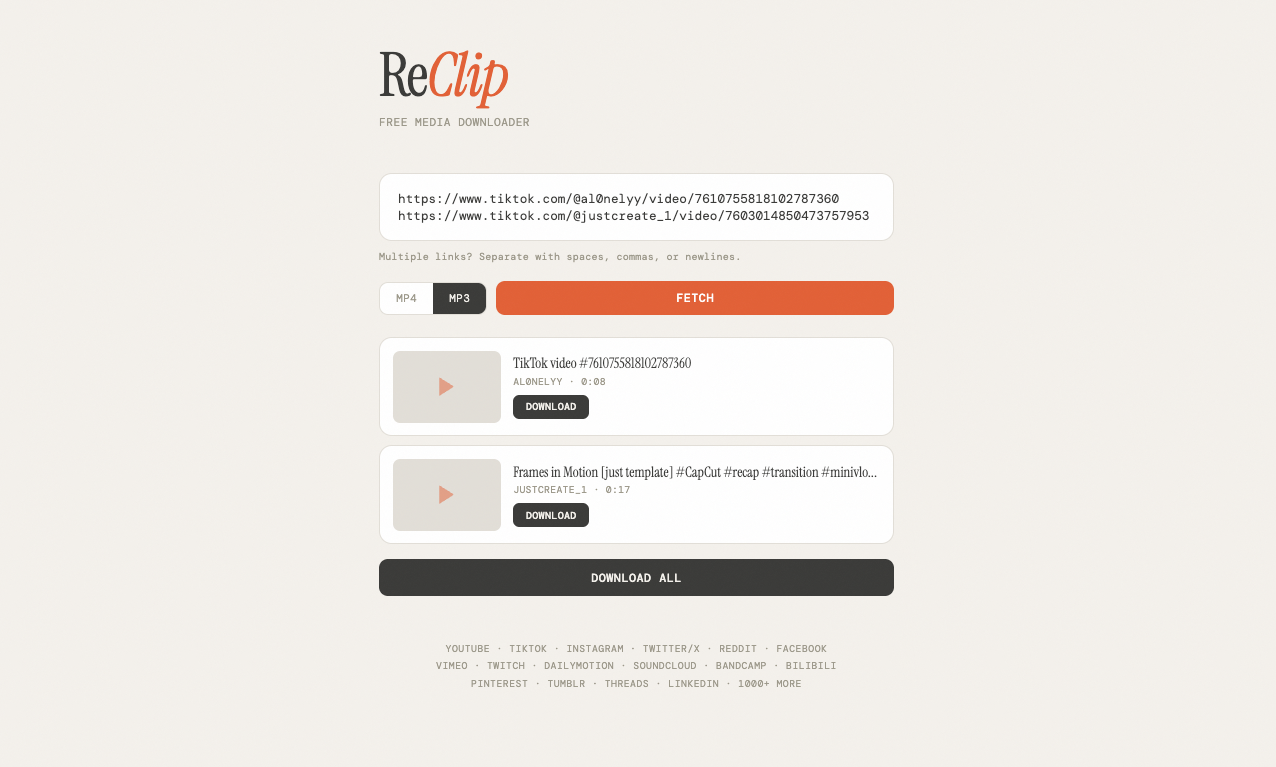
april 17, 2026
ReClip
ReClip
A self-hosted, open-source media downloader supporting 1,000+ platforms via yt-dlp. Forked from averygan/reclip and improved with Android deployment, security hardening, performance optimization, and automated testing — all authored by Google Jules and reviewed through GitHub Copilot.
The Problem
The original ReClip was a clean, minimal media downloader — Python + Flask backend, vanilla HTML/CSS/JS frontend, roughly 150 lines of backend code. It worked well on macOS and Linux desktop environments, but had several gaps:
- No mobile/Android deployment story
- No production-grade WSGI server (ran Flask's dev server)
- A command injection vulnerability in yt-dlp argument construction
- No test coverage for the download API
- Performance bottlenecks in string sanitization routines
- High cyclomatic complexity in the core download function
The Solution
Forked the repository and used Google Jules as an AI coding agent to systematically address each gap across 9 pull requests. GitHub Copilot provided automated code review, and Jules iterated on feedback before merge.
Android / Termux Deployment
- Replaced Flask's development server with Waitress (WSGI) for production-grade concurrency with configurable thread count via
WAITRESS_THREADS - Integrated aria2c as an external multi-threaded downloader for yt-dlp
- Created
install.shfor one-click Termux setup — installs Python, FFmpeg, Git, Aria2, Termux-API, and Cloudflared automatically - Created
start-background.shfor persistent background execution vianohupwith PID tracking and log output - Optional Cloudflare Quick Tunnel exposure via
ENABLE_CLOUDFLARED_TUNNEL=1with explicit security warnings - Automatic
termux-wake-lockacquisition to prevent Android from suspending background processes - Full deployment documentation in
DEPLOYMENT.md
Security Hardening
- Fixed argument injection vulnerability in yt-dlp command construction — user-supplied URLs starting with hyphens were interpreted as CLI flags
- Added
--separator before URL arguments in bothget_infoandrun_downloadto force positional argument parsing - Cloudflare Tunnel exposure changed from automatic to opt-in with security guidance documentation
Performance Optimization
- Replaced character-by-character generator expression with pre-compiled
re.sub()for filename sanitization - Short titles: 32% faster, long titles: 90% faster (100K operations)
- Pre-compiled
RE_UNSAFEregex pattern: 47% reduction in execution time (6.71s → 3.53s over 1M iterations)
Code Quality
- Moved inline imports to top-level per PEP 8 with
HAS_WAITRESSflag for optional dependency handling - Extracted
_build_download_commandand_finalize_downloadhelpers to reduce cyclomatic complexity inrun_download - Added pytest test suite for
/api/downloadcovering missing URL, empty URL, missing JSON body, and valid request paths - Fixed crash on POST requests with missing JSON body (
request.json or {})
Highlights
| Area | Impact |
|---|---|
| PRs shipped | 8 merged, 1 closed |
| Security | Argument injection vulnerability patched |
| Performance | 32–90% faster filename sanitization |
| Testing | Full pytest suite for download API |
| Deployment | One-command Android/Termux install |
| Server | Production Waitress WSGI replacing Flask dev server |
| Accessibility | Public tunnel via Cloudflare with opt-in security |
Results
- Fully functional self-hosted media downloader running on Android via Termux
- Accessible at
localhost:8899or via public Cloudflare Tunnel URL from any device - Supports YouTube, TikTok, Instagram, Twitter/X, Reddit, Facebook, Vimeo, Twitch, SoundCloud, and 1,000+ other platforms
- MP4 video and MP3 audio extraction with quality/resolution selection
- Bulk downloads with automatic URL deduplication
- ~990 lines added, ~340 lines deleted across the fork
What I Learned
Google Jules paired with GitHub Copilot code review creates a surprisingly effective contribution pipeline. Jules handled everything from deployment scripting to security patching to performance profiling — all from task descriptions sent via phone. The AI-to-AI feedback loop (Jules writes, Copilot reviews, Jules fixes) caught real issues: suppressed JSON output, hardcoded port values, unreliable environment detection, and public tunnel exposure risks.
The entire contribution — 9 PRs, 8 merged — was done from a phone on a train with no IDE. AI coding agents have fundamentally changed what "I don't have time to contribute" means.